Sunday, 29 June 2014

NEWSLETTER #12 - SOCIETY OF AFRICAN EARTH SCIENTISTS


Volume 3, Issue No. 1 , January/March 2014


CONTENTS

  • Chair's Foreword
  • Promoting Solar and Other Renewables in Africa
  • Report on Day Of earth Sciences in Africa and Middle East - SAES Climate Science Activity
  • Earth Science Events


Foreword by the Chair of Society of African Earth Scientists, Dr  Chukwunyere Kamalu

Welcome to the twelfth issue of the newsletter of the Society of African Earth Scientists (SAES), which will now be issued quarterly.
   In the current issue I report on my visit to the European Energy Centre at Edinburgh Napier University in the light of the promotion of solar and other renewable energies in Africa and also the recent activity carried out by SAES for Day of Earth Sciences in Africa and Middle East, which is annually organised by Association of African Women in the Geosciences.

Promoting solar and other renewables in Africa1

   In March I attended two courses at the European Energy Centre, Edinburgh Napier University (wind power and solar photovoltaics) where I met a number of African scientists and engineers who were fellow participants. In the intervening breaks we had numerous discussions about African renewable energy. I made some inspiring connections. In the wind power course I met a member of the Congolese opposition party, who already are devising strategies for renewables for when (if) they get into power.
   I also had the privilege of meeting, Suleiman Babamanu, a young research scientist from NASENI (Nigerian Agency for Science and Engineering Infrastructure) who is working at the newly established Karshi solar panel manufacturing plant in Abuja, Nigeria. I was encouraged to hear his plans for promoting the uptake of solar in Nigeria. 
   Many in the field would agree  that the barrier currently existing against the great uptake of solar, is the notion that solar is so exorbitantly expensive as to be inaccessible. But this is far from the truth, as the cost of solar is falling daily, especially in comparison to fossil fuels which are rising in price. 
   Current wisdom would dictate, that the greatest effort should be put into educating the younger generation about solar and renewables, as the young are most likely to exploit the future opportunities that lie in this energy. I asked Suleiman to update me on his future efforts in regard to promoting this technology among the young, which may include solar energy workshops delivered to local secondary school pupils in Abuja,  in conjunction with schools trips to the Karshi solar panel manufacturing plant.  
   In the future eventually Africans will need to take control of the entire solar panel  production process. At present the silicon solar cells that are assembled to manufacture each panel at the Karshi Plant in Abuja,  are imported from China. For the moment this part of the process is too expensive for most African countries to afford as the making of silicon solar cells (essentially from melting sand to form crystalline solar cells at very high temperatures) is very energy intensive and therefore prohibitively expensive; so it is probably cheaper at present to be importing silicon cells from China. With a solar panel manufacturing plant Nigeria can be poised for a solar energy revolution, for which I believe  plans like those of Mr Babamanu at the Karshi plant, to sow the seed of renewable energy appreciation in the minds of the youth, are absolutely of key importance4.


A Climate Science Activity Hosted by the Society of African earth Scientists on 19th-21st March 2014 as Part of Day of earth Sciences in Africa and Middle East

 On 19th-21st March 2014 ,the Society of African Earth Scientists (SAES) participated  in the Association of African Women in the Geosciences-led, “Day of Earth Sciences in Africa and the Middle East”.
   The Society, as a partner in the event, hosted a climate science  activity involving the measurement of the size distribution  of local raindrops using the standard flour pellet method2,3.  The project was aimed at African and African diaspora schools. London storm raindrop samples were collected on behalf of the Caraf Centre Supplementary School in Camden, London and analysed. The poster below displays results of the analysis:-


Figure 1 SAES Raindrop Size & Size distribution test results  - DESAMES 2014
  

The activity led to the programming of further work, with a workshop planned at the Caraf Centre in late June to demonstrate the measurement of raindrop sizes using the flour pellet test. The workshop to be delivered in June, for primary age pupils of Caraf, will focus on why raindrops are not of uniform size (4A)  and other basic facts.


Figure 2 Climate Change Workshop notice -  Caraf Centre, June 2014


The Caraf workshop is the start of the “Rainscience Project”, an SAES climate science  project involving African and African diaspora schools using the simple flour pellet test method as an engaging way to impart and encourage the development of practical science investigation skills.


Affiliation and Association with other organisations

SAES is affiliated to the African Association of Women in the Geosciences, Solar Sister, and is an active supporter of the African led counter land grab initiatives, Stop Africa Land Grab and Stop Land Grabbing.

Earth Science Events

19,20, 21  March 2014
Association of African Women in the Geosciences - Day for Earth Sciences in Africa and Middle East  "Geoeducation, geoheritage and Peace building in Africa and Middle East"
Venue: International
The African Association of Women in Geosciences and the African Geoparks Network are proclaiming the 20th March as a “Day for Earth Sciences in Africa and the Middle East”
to increase the awareness about the role that earth scientists could play to help to build a peaceful, healthier and wealthier continent. This day was first celebrated in 2013. In 2014, the day will be celebarated under the title "Geoeducation, Geoheritage and Peace Building in Africa and Middle East".

14-16 August 2014
3rd Young Earth Scientists Congress, 25th Colloquium on African Geology
“Earth Sciences for Improving Livelihood in Africa”
Venue: Mwalimu Julius Nyerere  Convention Centre, Dar Es Salaam, Tanzania
“CAG in Brief: The Colloquium of African Geology (CAG) is a major biennial meeting organized under the auspices of the Geological Society of Africa (GSAf). Since the first Colloquium in 1965, the Colloquia have been hosted by several European and African countries. The African countries that had a chance to organize this event were Swaziland, Zimbabwe, Morocco, Mozambique, Tunisia, South Africa and Ethiopia. Based on the decision of the Geological Society of Africa (GSAf) General Assembly held on 14th January 2013 at the Millennium Hall, Addis Ababa, Ethiopia (during the 24th Colloquium), the organization of the next Colloquium of African Geology (CAG25) as well as the 15th Conference of the Geological Society of Africa was assigned to Brazil. However, because of administrative problems in organizing the 25th CAG along with the Brazilian Geological Society of Brazil Conference in September 2014, the GSAf Council members decided to move the CAG25 to another country. Based on the discussion between Prof. Aberra Mogessie (President of the Geological Society of Africa) and Prof. Sospeter Muhongo, Minister of the Ministry of Energy and Minerals of the United Republic of Tanzania, in Graz Austria, in August 2013 it was decided to organize the CAG25 back to back with the 3rd YES Congress in Tanzania. This decision was approved by the GSAf Council members. The CAG25 is an independent meeting which will be organized by the Tanzania Geological Society (TGS) under the auspices of the GSAf.”

15-19 September 2014
41st Congress of International Association of Hydrogeologits: Challenges and Strategies

Venue: Marrakech, Morocco.

3-9 November 2014
The African Association of Women in Geosciences (AAWG)
Organize its seventh conference
under the title
"Earth Sciences and Climate Change: Challenges to Development in Africa"
Windhoek, Namibia, November 03-09, 2014
PREAMBLE
AAWG supports the development of Earth Scientists in Africa by providing opportunities for networking and applying science for the sustainable development challenges the continent is facing. Opportunities for earth scientists are great, extending from traditional mineral extraction to environmental management such as climate change adaptation, prevention of natural hazards, water scarcity, and ensuring access to quality earth science training. To assist African governments to realize opportunities, AAWG activities are developed through a participatory approach. International conferences have been organized to address various issues that affect the African continent, to which Earth Scientists can make a contribution. The 7th AAWG conference is being organized, taking into consideration the current challenges the continent is facing in view of the changing climatic conditions, which is threatening sustainable development agenda in Africa.
CONFERENCE SUB-THEMES
Women and climate change
Earth Science: History
Earth and its Dynamics
Earth and Life
Pedology and Pedogenesis
Global Warming and Climate Change
Earth and Ecology
Medical Geology
Earth Science and Hydrology
Applications of Earth Sciences
Petrology
Earth and Environmental Science
Archaeology and paleontology
Geoheritage, Geotourism and climate change
Earth Sciences and local communities


References and Selected Reading

1. From March 2014 SAES FB posting
2. Bentley, W.A., 1904, Studies of raindrops and raindrop phenomena, Monthly Weather Review, 32: 450-456. 
3. Salako, F.K., 2003, Susceptibility of coarse textured soils to soil erosion by water in the tropics, University of Agriculture, Abeokuta, Nigeria.
4A. "Why raindrops come in many sizes", http://news.bbc.co.uk/1/hi/sci/tech/8155883.stm
4. The Karshi solar panel plant: https://www.youtube.com/watch?v=-ZUu7yzkasc
5. Jordan, et al (eds), Land & Power:  Sustainable agriculture and African Americans - A collection of essays from the 2007 Black environmental thought conference. Sustainable Agriculture Research and Education (SARE), 2007.
6. Gupta, S.K., Modern Hydrology and Sustainable Water Development, Wiley-Blackwell, West Sussex, 2011.
7. A link on “Groundwater and Rural Water Supply in Africa”: http://www.iah.org/downloads/occpub/IAH_ruralwater.pdf
8. Link to Journal of African Earth Sciences: http://www.journals.elsevier.com/journal-of-african-earth-sciences/


Saturday, 1 March 2014

NEWSLETTER #11 - SOCIETY OF AFRICAN EARTH SCIENTISTS


Volume 2,  Issue No. 5, October/November 2013


Content
  • Chair’s Foreword
  • Micro Hydro-power in Africa
  • Earth Science Events
  • Suggested Reading and links

Micro hydro-power scheme supplying electricity to a Kenyan village (Practical Action)

Foreword by the Chair of Society of African Earth Scientists, Dr Chukwunyere Kamalu
Welcome to the eleventh issue of the bi-monthly newsletter of the Society of African Earth Scientists (SAES).

Micro-hydropower in Africa
According to many assessments, Africa has great untapped hydropower potential. It is useful to note that the Libyan government under Ghaddafi, made an assessment of African hydropower resources.  The report estimates that only 20% of Africa’s hydro-power potential has been tapped.  The assessment is a document generated by the Ministerial Conference on Water for Agriculture and Energy in Africa: The Challenges of Climate Change, and was entitled “Hydropower Resource Assessment of Africa”[4]. Others (e.g., Klunne [1, 3]) estimate that less than 7% of this hydropower potential has actually been tapped. Throughout Africa, from east to west, north to central and  southern Africa, there is a wealth of permanent rivers with untapped hydropower potential. Many of these sites offer the opportunity for the establishment of so called “run-of-the-river” schemes which do not require the construction of dams or reservoirs to facilitate the exploitation of hydropower potential.
   The Libyan report outlines some of the obstacles to implementation of small hydropower schemes in Africa, which include:
 1. Lack of capacity to manufacture rudimentary parts for turbines
2. Lack of capacity to design and develope small schemes for remote regions
3. Lack of access to the appropriate technology to facilitate mini-, micro- and  pico-hydropower projects

One can point to existing UN assisted small and micro hydropower projects in Africa [1], that illustrate the potential that small hydropower promises for the continent’s electrification. For instance, the United Nations Environment Programme are implementing a Global Environment Facility funded project that looks at the possibility of applying small hydro at  tea estates in East Africa to generate electricity. In West Africa, the United Nations Development Programme is implementing a Global Environment Facility assisted project to promote decentralised off-grid  rural electrification in 10 countries.
   One can also point to examples of community based hydropower schemes in Zimbabwe [2,3] and in Kenya[1,3]. The Tungu-Kabiri community hydro project in Kenya facilitated the installation of a micro-hydropower scheme for the local community that is both owned and managed by the local community. In Zimbabwe, the Chipendeke and Pungwe River micro hydropower plants are also owned and managed by their respective local communities. The hydropower plant at Chipendeke has had many indirect benefits as a result of the power plant. Electrification has served to boost local business and services, including chicken rearing and improved electricity supply to clinics and local schools.
   In conclusion, micro-hydropower in Africa represents an opportunity to add significantly to Africa’s renewable energy capability.  It should be no surprise to see the growth of micro hydropower, since micro-hydropower requires low level investment and the benefits are seen in the short term[4]. The crucial point has been made that micro-hydropower development needs to be embedded in national capacity building and industrial development programmes[1]. It is a point we hope African governments seriously address, as the potential rewards in terms of development in the rural areas  of the continent are great.

Affiliation and Association with other organisations
SAES is affiliated to the African Association of Women in the Geosciences, Solar Sister, and is an active supporter of the African led counter land grab initiatives, Stop Africa Land Grab and Stop Land Grabbing.

Earth Science Events
  
November 24-26,  2013
7th International Conference on African Geology
Venue: Assiut, Egypt
A conference to present new advances, and research results in the fields of theoretical, experimental and applied geology of Africa.

March 19, 20, 21,   2014
Association of African Women in the Geosciences –
Day for Earth Sciences in Africa and Middle East  "Geoeducation, geoheritage and Peace building in Africa and Middle East"
Venue: International
The African Association of Women in Geosciences and the African Geoparks Network are proclaiming the 20th March as a “Day for Earth Sciences in Africa and the Middle East”
to increase the awareness about the role that earth scientists could play to help to build a peaceful, healthier and wealthier continent. This day was first celebrated in 2013. In 2014, the day will be celebarated under the title "Geoeducation, Geoheritage and Peace Building in Africa and Middle East".

August 14-16, 2014
3rd Young Earth Scientists Congress, 25th Colloquium on African Geology
“Earth Sciences for Improving Livelihood in Africa”
Venue: Mwalimu Julius Nyerere  Convention Centre, Dar Es Salaam, Tanzania
“CAG in Brief: The Colloquium of African Geology (CAG) is a major biennial meeting organized under the auspices of the Geological Society of Africa (GSAf). Since the first Colloquium in 1965, the Colloquia have been hosted by several European and African countries. The African countries that had a chance to organize this event were Swaziland, Zimbabwe, Morocco, Mozambique, Tunisia, South Africa and Ethiopia. Based on the decision of the Geological Society of Africa (GSAf) General Assembly held on 14th January 2013 at the Millennium Hall, Addis Ababa, Ethiopia (during the 24th Colloquium), the organization of the next Colloquium of African Geology (CAG25) as well as the 15th Conference of the Geological Society of Africa was assigned to Brazil. However, because of administrative problems in organizing the 25th CAG along with the Brazilian Geological Society of Brazil Conference in September 2014, the GSAf Council members decided to move the CAG25 to another country. Based on the discussion between Prof. Aberra Mogessie (President of the Geological Society of Africa) and Prof. Sospeter Muhongo, Minister of the Ministry of Energy and Minerals of the United Republic of Tanzania, in Graz Austria, in August 2013 it was decided to organize the CAG25 back to back with the 3rd YES Congress in Tanzania. This decision was approved by the GSAf Council members. The CAG25 is an independent meeting which will be organized by the Tanzania Geological Society (TGS) under the auspices of the GSAf.”


References and Selected Reading
1. Klunne, W.J., Small Hydro-power Development in Africa, ESI Africa, Issue 2, 2007.
2. Think Africa, Zimbabwe: Bringing Hydro power to the People, May 2012.  http://thinkafricapress.com/zimbabwe/micro-hydropower-eastern-highlands-pungwe-river
3. Klunne, W.J., Micro Hydropower in Rural Africa, Challenge, Spring 2011. http://energy4africa.net/klunne/publications/challenge_Spring2011_hydropower.pdf
4. Water for Agriculture and Energy in Africa, Hydro Power Assessment of Africa, Dec. 2008. http://www.sirtewaterandenergy.org/docs/2009/Sirte_2008_BAK_3.pdf
5. Gupta, S.K., Modern Hydrology and Sustainable Water Development, Wiley-Blackwell, West Sussex, 2011.
6. A link on “Groundwater and Rural Water Supply in Africa”: http://www.iah.org/downloads/occpub/IAH_ruralwater.pdf
7. Link to Journal of African Earth Sciences: http://www.journals.elsevier.com/journal-of-african-earth-sciences/ 
Sunday, 16 February 2014

DAY OF EARTH SCIENCES IN AFRICA


A CLIMATE CHANGE MONITORING ACTIVITY TO BE HOSTED BY THE SOCIETY OF AFRICAN EARTH SCIENTISTS 0N 19-21ST MARCH 2014 AS PART OF DAY OF EARTH SCIENCES IN AFRICA 

The Society of African Earth Scientists (SAES) will on the 19th-21st March 2014 be participating in “Day of Earth Sciences in Africa “as part of the Association of African Women in the Geosciences-led, “Day of Earth Sciences in Africa and the Middle East”. The Society, as a partner in the event, will be hosting a climate change monitoring activity involving the annual measurement of the size distribution  of local raindrops using the standard flour pellet method.  All participants are invited to post their results on the SAES facebook page or to email them to saescientists@hotmail.co.uk. It is hoped to involve schools in Africa and the diaspora.

Activity Summary
   To measure the size distributions of local raindrops, using the flour pellet method.

Outcome
   The SAES hosted activity will

  •  Demonstrate a valuable earth science research method that requires little resources and is affordable and simple to perform.
  •  Potentially result in the collection of useful research data of use in monitoring of climate change.
  • Serve to illustrate the role of earth science in Africa
Background
   Raindrop sizes appear to increase with increasing rain intensity. But studies in tropical climates where rainfall is heavier have shown that this is only true for low intensities less than 100 mm/hr. Beyond this intensity range, we find that raindrops are smaller in size as rain intensity increases. Although no direct references are available, it has been posited within the scientific community that climate change affects the pattern of raindrop size distributions. We may, for instance, in the future see a predominance of raindrops falling into the larger size class, with fewer drops occupying the smaller size classes. Or we might see something unexpected which contradicts this. Our experiments would positively contribute to the current situation where there are too few studies to show that raindrop sizes or size distributions give an indication of climate change – although this may indeed be true.
   Raindrop sizes vary globally from (approx) 1-2 mm median size in temperate climates, to 3mm and above in the tropics.  Salako (2003) gives the following data for raindrop sizes determined using the flour pellet test, in Nigeria.

Table 1  Raindrop Sizes Determined by the Flour Pellet Test in Nigeria (Salako, 2003)
Agroecological Zone
Maximum Drop Size (mm)
Median Drop Size (mm)
Source
South Eastern Nigeria savanna
3.4
1.1-2.9
Obi and Salako (1995)
South Central Nigeria,  humid forest
5.1
2.3
Salako et al. (1995)
South Western Nigeria, humid forest
4.5
3.0
Aina (1980)

   Typically, tropical rainfall will achieve intensities as high as 150 mm per hour. The annual rainfall of temperate climates is typically 600mm per year (in UK for instance) whereas that of tropical climates reaches levels of 1000-1500mm, as in West Africa.
   Measuring the size of raindrops is most simply performed by the flour pellet method[i] , which is performed by catching raindrops in pans of flour and weighing the pellets that they form, after they have been both air dried and dried in an oven.
Detailed Description of the Activity

Objective:
   The Society of African Earth Scientists’ Earth Science Day activity invites us to measure the raindrop size distributions in our local area using the flour pellet method.

Apparatus:
1)   A quantity of plain baking  flour
2)   Particle size analysis sieves: 710 µm, 1.00 mm, 1.40 mm, 1.70 mm, 2.00 mm,  2.36 mm, 2.80 mm 
3)   Sampling pans (e.g. aluminium baking tray 32cmx22cm x3.5cm*)
*Although dimensions are specified, participants should not feel inhibited from using alternatives at their disposal. The main objective is to collect good samples of raindrops that are as approximately spherical and unspoiled as possible. In this case 3cm depth to prevent samples spoiling by splashing is crucial to maintain the quality of samples whilst sufficient tray  width will enhance the size of the sample


Procedure:
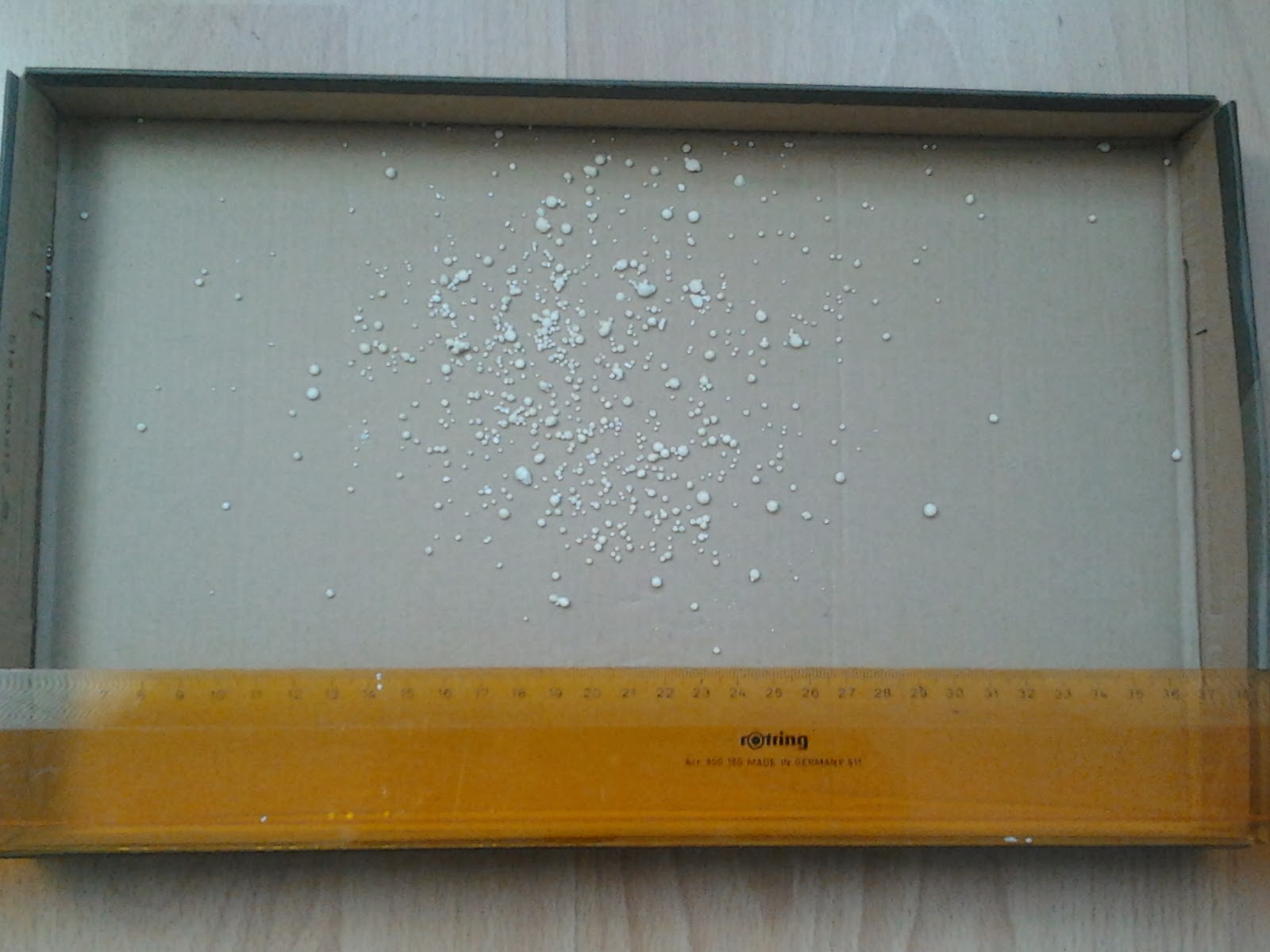
   In summary, we aim to capture samples of raindrops from a typical local storm in the period February – March, around the Annual Day of Earth Sciences in Africa. To catch the raindrop samples we fill a rectangular baking tray filled with plain baking flour to a depth of 3 cm. The raindrops are then sampled by taking two samples over a ten minute period within a typical storm. Figure 1 shows sampled raindrops in a pan filled with baking flour.


Figure 1   Raindrop flour pellet samples collected in a pan filled with 3cm depth of baking flour

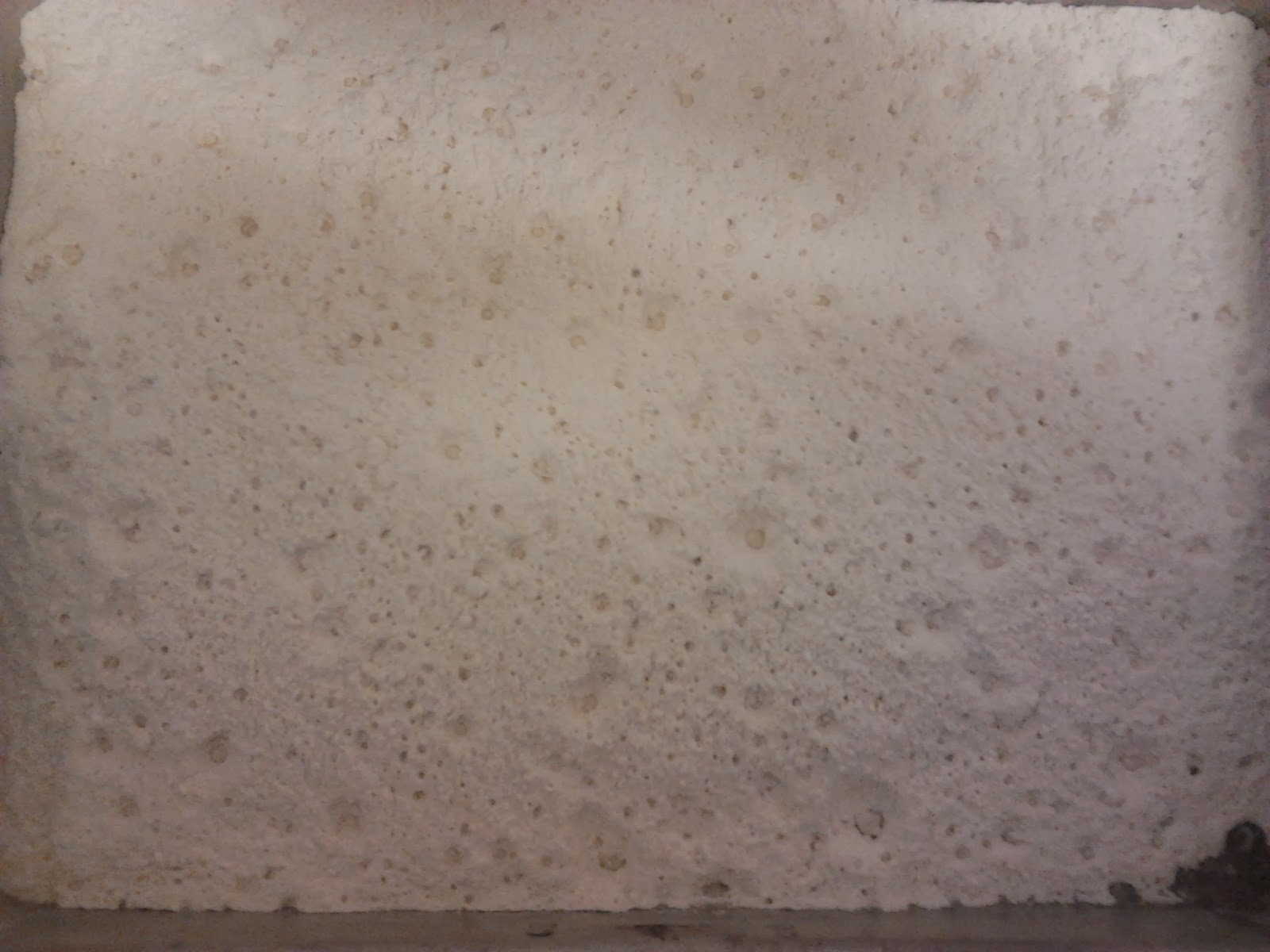
   The pan or tray of collected drop samples is then left to air dry for 2 hours before being further dried for a further 2 hours in the oven at about 105 degrees centigrade.  In strict research procedure, a drying time of 12 hours in an oven at 105 degrees C may be required. But recognising limitations in time and resources for this exercise (power cuts could not guarantee 12 hours of  oven drying in some instances) we can be flexible, but still obtain good flour pellet samples. If no oven is available, then air drying for 5 to 12 hours (depending on the local climate) is probably sufficient to obtain hard dried pellet samples as shown in figure 2.
   Once the flour pellet samples are dried, they are  sorted into size classes by sieving through varied size meshes: 710 µm (or  0.71 mm),  1 mm, 1.4 mm, 1.7 mm, 2.0 mm, 2.36 mm, 2.8 mm. The pellets falling into each size class are weighed and then counted.
   Figure 2 shows the dried pellet samples of a London storm collected by the author. Photography gives us an opportunity to include those participants who are unable to obtain the necessary sieving equipment, but who can still participate by collecting raindrop samples as described above, drying them and sieving them with a standard tea strainer, and sending in photographs of the flour pellets displayed adjacent to a clearly graduated ruler graduated in millimetres (mm).  Although laborious, we can use photographs to estimate the size of the pellets and sort them into their respective size classes.


Figure 2   Flour pellets after air and oven drying, ready for size analysis

   Rigour requires that we calibrate the flour that we are using by capturing a sample of water drop of a known size. To simplify matters we require only that participants record the source of their baking flour stating the source or the brand name of the flour. The flour can be calibrated at a later stage using information on the source of the flour.
   The following is an example of the results table of flour pellet samples collected by the author in a test sampling simulated rain.

Table 2   Flour pellet test results table
A
B
C
D
E
SIZE CLASS
NO. OF DROPS
WT OF ALL PELLETS  (g)
WT OF MEAN PELLET (mg)
W
RAINDROP DIAMETER (mm)
Dr
2.8 mm
16
0.307
19.175
3.21
2.36 mm
14
0.133
9.514
2.63
2.0 mm
37
0.205
5.546
2.20
1.7 mm
71
0.256
3.611
1.90
1.4 mm
128
0.266
2.08
1.58
1.0 mm
396
0.447
1.129
1.29
710 µm
1050
0.395
0.376
0.89

   From the number of raindrops and weight of pellets in each class (columns B and C)  we are able to determine the mean weight of a pellet (column D) by dividing the weight of pellets in each class by the number of raindrops in that class. The diameter of raindrops in the class can then be determined by the following formula

Dr   =  [ (6/π) xW ]1/3                                ..........................   (1)
where W is the mean pellet weight  and Dr is the raindrop diameter.

Results:
   Please record the date of collection of flour pellet samples. This must accompany any results submitted.  Under the guidance of their tutor, it is sufficient for younger students to record in table form (as in table 2, columns A to D), results of the counting of the pellets and weighing of the pellets in each size class   to complete the exercise for DAY OF EARTH SCIENCES.  Older students (12-13 years old and upwards),   can use the data from the table with equation (1) to determine the raindrop diameters corresponding to their results and hence complete the results table  (as in table 2, columns A to E) to include raindrop diameters.  Please email your results to: saescientists@hotmail.co.uk  anytime during 19-21st March 2014.


Society of African Earth Scientists, February 2014


REFERENCES
  1. Bentley, W.A., 1904, Studies of raindrops and raindrop phenomena, Monthly Weather Review, 32: 450-456. 
  2. Salako, F.K., 2003, Susceptibility of coarse textured soils to soil erosion by water in the tropics, University of Agriculture, Abeokuta, Nigeria.


[i] first developed by Bentley (1904),